

Decentralized Clinical Trials Market to reach USD 35.62 Billion by 2035 at 13.4% CAGR
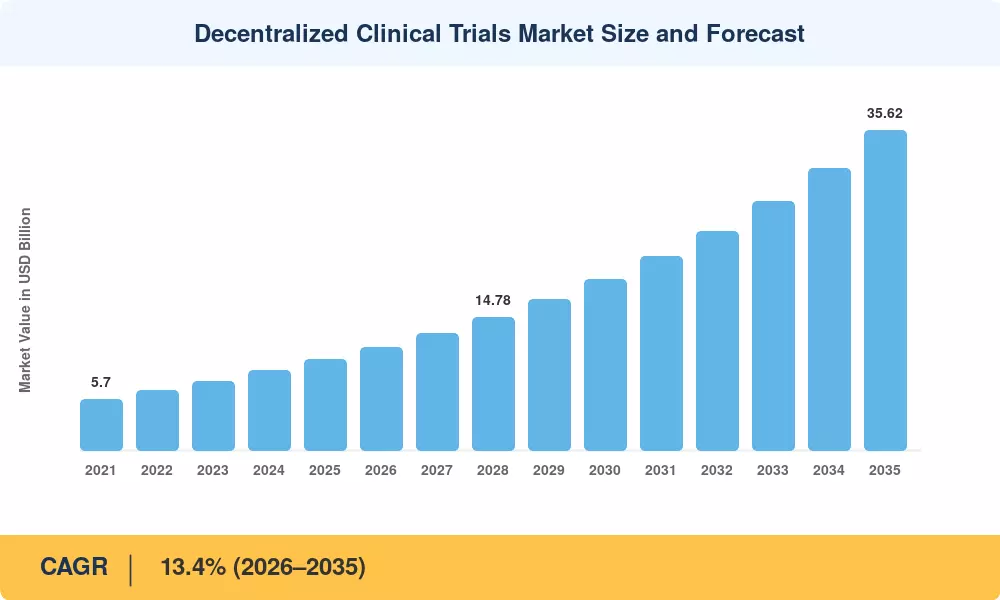
Decentralized Clinical Trials Market (2026 - 2035)
Decentralized Clinical Trials Market to Surge from USD 10.13 Billion in 2025 to USD 35.62 Billion by 2035—By Regulatory Endorsement, Recruitment Cost Pressure
NY, CA, UNITED STATES, September 8, 2026 /EINPresswire.com/ -- As per Market Research Future, the global Decentralized Clinical Trials Market size is projected to reach USD 35.62 Billion by 2035 from USD 10.13 Billion in 2025, at a CAGR of 13.4% during the forecast period 2026–2035. The market base was estimated at USD 10.13 Billion in 2025, with the first year of the forecast period (2026) valued at USD 11.49 Billion.The 13.4% CAGR is propelled by three converging forces: regulatory endorsement converting pilots into programs, with the FDA's September 2024 final guidance on decentralized elements giving sponsors a defensible regulatory path for remote visits and direct-to-patient shipment; recruitment and retention cost pressure, with approximately 32% of Phase III trial expenses going on patient recruitment, and decentralized enrollment reducing time-to-full-enrollment by 22–29% for qualifying protocols; and connected sensor and wearable maturity, with sensor-derived endpoints moving from exploratory to registrational, and hardware cost per enrolled patient falling 41% between 2021 and 2025.
Global regulatory agencies and pharmaceutical leaders are amplifying this momentum. The EU Clinical Trials Regulation's harmonized submission portal cut multi-country approval friction that had previously made distributed protocols commercially unattractive. Venture and strategic capital committed roughly USD 4.1 billion to clinical trial technology platforms between 2022 and 2025, with connected-device integration absorbing the largest share. Registry classification shows decentralized elements in 28.6% of new interventional protocols filed during 2025, against 17.4% three years earlier.
Request A Free Sample:
https://www.marketresearchfuture.com/sample_request/43170
Key Market Trends & Growth Drivers
Regulatory Endorsement Converts Pilots into Programs
Sponsors treated decentralized designs as experimental until regulators wrote them down. The FDA's 2024 guidance addressed telehealth visits, local healthcare provider involvement, and investigational product shipment in specific operational language, removing the ambiguity that compliance officers had used to block scale-up. Uptake followed quickly: decentralized elements are now present in 28.6% of new interventional protocols filed during 2025, against 17.4% three years earlier.
Recruitment Economics Force the Business Case
Approximately 32% of Phase III trial expenses go on patient recruitment, with screen-failure and dropout rework contributing significantly more. For indications with incidence < 1 in 10,000, distributed enrollment greatly expands the catchment radius beyond a 90-minute drive from an academic center. When home-based clinical trials take the place of site-only recruiting for qualifying protocols, sponsors report time-to-full-enrollment reductions of 22–29%.
Sensor Maturity Turns Endpoints Continuous
Wearable-derived endpoints moved from exploratory to registrational in a narrow band of indications—gait in neuromuscular disease, nocturnal scratch in atopic dermatitis, ambulatory rhythm in cardiology. The Digital Medicine Society's evidentiary framework gave sponsors a shared vocabulary for validation, cutting the qualification cycle by an estimated eight months. Hardware cost per enrolled patient fell 41% between 2021 and 2025.
Protocol Complexity Rewards Distributed Execution
Average Phase III protocols now carry 263 discrete procedures, up nearly a third across a decade. Each added procedure raises the per-visit burden that drives withdrawal. Shifting low-complexity assessments off-site preserves the data while protecting retention—the core operating logic of the Decentralized Clinical Trials Market.
Ask for Customization:
https://www.marketresearchfuture.com/ask_for_customize/43170
Market Segment Insights
BY STUDY DESIGN
Interventional Trials: Largest segment with 62.4% share in 2025, driven by pivotal program budgets. Interventional spend concentrates in Phase II and III, where per-patient budgets justify platform licensing.
Observational Trials: Significant segment with 29.1% share in 2025, converting faster because they carry lighter validation obligations and can tolerate consumer-grade devices.
Expanded Access: Niche segment with 8.5% share in 2025, driven by compassionate use logistics.
BY COMPONENT
Cloud-Based Platforms: Largest segment with 38.4% share in 2025, reflecting unified sponsor workflow demand. Cloud platforms hold share because sponsors prefer one contract over six.
Connected Devices & Wearables: Fastest-growing component at 15.9% CAGR (2026–2035) , driven by continuous endpoint capture. Device revenue grows faster but from a smaller base.
Software (eConsent, ePRO, eCOA): Significant segment at USD 2.34 Billion in 2025, driven by regulatory documentation requirements.
Services & Site Enablement: Significant segment at USD 2.41 Billion in 2025, driven by home visit and logistics coordination.
BY THERAPEUTIC APPLICATION
Oncology: Largest segment with 31.2% share in 2025, driven by dispersed rare-tumor cohorts. Oncology leads on value despite operational difficulty.
Neurology: Significant segment with 18.6% share in 2025, driven by motion and cognition sensor endpoints. Growth reflects genuine endpoint innovation rather than logistics convenience.
Cardiology: Significant segment with 16.4% share in 2025, driven by ambulatory rhythm monitoring.
Infectious Diseases: Significant segment with 12.8% share in 2025, driven by outbreak-responsive enrollment.
BY END-USER
Pharmaceutical & Biotech Sponsors: Largest segment with 54.6% share in 2025, anchoring market demand through direct pipeline execution.
Contract Research Organizations: Fastest-growing end-user at 14.7% CAGR (2026–2035) , driven by service bundling strategy as they internalize platform capability.
Medical Device Companies: Significant segment at USD 1.02 Billion in 2025, driven by post-market surveillance obligations.
Academic & Research Institutes: Significant segment with 9.8% share in 2025, driven by grant-funded pragmatic studies.
Read Detailed Insights:
https://www.marketresearchfuture.com/reports/decentralized-clinical-trials-market-43170
Regional Outlook
Asia-Pacific — Dominant Market (~34.8% Share, 2025)
Asia-Pacific leads the Decentralized Clinical Trials Market, built on China's NMPA reform cycle and India's expanding investigator base. China's dominance rests on scale—volume of protocol starts, breadth of hospital networks, and a domestic biopharma sector that quadrupled pipeline assets across a decade. India competes differently, offering investigator experience and English-language documentation that shortens sponsor onboarding. India's CDSCO cut ethics committee turnaround to a median of 42 days in 2025.
North America — Fastest-Growing Region (15.1% CAGR, 2026–2035)
North America records the fastest regional CAGR, propelled by sponsor consolidation and Medicare-linked pragmatic trial funding. United States activity concentrates around the top 20 sponsors, who together account for a disproportionate share of decentralized protocol starts. NIH's pragmatic trial collaboratory funded 23 distributed studies through 2025, establishing operational templates that commercial sponsors have copied.
Europe — Significant Market (USD 2.29 Billion, 2025)
Europe holds a significant share at 22.6%, where the Decentralized Clinical Trials Market is shaped less by cost arbitrage than by GDPR-compliant data architecture. Germany leads with a 23.1% share, while the UK's NHS DigiTrials service demonstrated what national-scale recruitment infrastructure can achieve. Nordic registries offer near-complete lifetime follow-up that makes distributed long-term safety studies feasible.
South America — Growing Presence (5.1% Share, 2025)
Brazil anchors the region with 58.3% of revenue. Brazil's 2024 clinical research law established statutory review deadlines that had previously been advisory, cutting median approval from 11 months to under six. That single change repositioned the country for sponsors who had written the region off on timeline risk.
Middle East & Africa — Emerging Opportunity (14.6% CAGR, 2026–2035)
Saudi sovereign funding has moved beyond hospital construction into research infrastructure, with the Health Sector Transformation Program allocating dedicated budget to clinical trial capability. South Africa retains genuine depth in infectious disease methodology built over three decades of HIV and TB research.
Competitive Landscape and Recent Developments
Concentration sits in medium territory, with the top five vendors holding roughly 41–47% of revenue. That structure reflects a market where large CROs bring scale and distribution while specialist platforms retain technical advantage in specific workflows.
KEY COMPANIES AND RECENT MILESTONES
IQVIA (June 2024): Acquired a European home-health nursing network to internalize mobile visit delivery, reducing third-party coordination cost per patient. Estimated ~11–14% revenue share.
Medidata (Dassault Systèmes) (March 2025): Extended Sensor Cloud to support 190+ validated device models, targeting sponsors running multi-modality continuous endpoint capture. Estimated ~9–12% revenue share.
Signant Health: Endpoint validation depth with eCOA, eConsent, and telemedicine visit management. Estimated ~7–9% revenue share.
ICON plc (February 2025): Launched a hybrid trial design accelerator combining protocol consulting with pre-validated technology configurations. Estimated ~5–7% revenue share.
Medable (October 2024): Announced a multi-year enterprise agreement covering 40+ protocols with a top-10 sponsor, signaling a shift from study-by-study to portfolio licensing. Estimated ~4–6% revenue share.
Other Key Players: Oracle Life Sciences, Parexel, Clario, Science 37, THREAD Research, Castor, Veeva Systems.
Recent Industry Developments:
FDA (September 2024): Published final guidance on decentralized elements in clinical investigations, formalizing telehealth visit and direct-to-patient shipment standards.
EMA (January 2025): Issued a reflection paper on remote source data verification, addressing an inspection ambiguity flagged repeatedly by sponsors.
CDSCO India (April 2025): Formalized acceptance of electronic informed consent for specified trial categories, removing a long-standing barrier to distributed enrollment.
Future Outlook: 2026–2035
The Decentralized Clinical Trials Market is projected to reach USD 35.62 Billion by 2035, growing at a CAGR of 13.4%, driven by regulatory endorsement, recruitment cost pressure, and connected sensor maturity.
New opportunities lie in:
Payer-Linked Real-World Evidence: Sponsors who build distributed data collection into pivotal programs can extend the same infrastructure into reimbursement dossiers, converting a trial cost line into a market-access asset.
Emerging-Market Trial Localization: Distributed models let sponsors reach patients in tier-2 and tier-3 cities without building permanent site infrastructure.
Data Monetization Through Federated Analytics: Platform suppliers with access to longitudinal sensor data may lease de-identified derivative knowledge to payers and device manufacturers.
Rare Disease Registry Convergence: Direct integration between registry platforms and trial systems shortens rare-disease enrollment from a median of 19 months to under 11.
Decentralized Post-Approval Safety Surveillance: Phase IV commitments carry lighter validation burden and larger populations—an efficient entry point for sponsors testing distributed operations.
By 2035, the Decentralized Clinical Trials Market is expected to achieve substantial growth, reflecting the industry's transition from site-centric to patient-centric clinical development.
More Related Research Insights:
https://www.marketresearchfuture.com/ja/reports/telemedicine-market-2216
https://www.marketresearchfuture.com/de/reports/telemedicine-market-2216
https://www.marketresearchfuture.com/fr/reports/surgical-robots-market-3025
https://www.marketresearchfuture.com/ja/reports/surgical-robots-market-3025
https://www.marketresearchfuture.com/de/reports/surgical-robots-market-3025
https://www.marketresearchfuture.com/es/reports/surgical-robots-market-3025
https://www.marketresearchfuture.com/zh-cn/reports/surgical-robots-market-3025
https://www.marketresearchfuture.com/ko/reports/surgical-robots-market-3025
https://www.marketresearchfuture.com/fr/reports/preclinical-cro-market-7274
https://www.marketresearchfuture.com/ja/reports/preclinical-cro-market-7274
Market Research Future
Market Research Future
+1 855-661-4441
email us here
Legal Disclaimer:
EIN Presswire provides this news content "as is" without warranty of any kind. We do not accept any responsibility or liability for the accuracy, content, images, videos, licenses, completeness, legality, or reliability of the information contained in this article. If you have any complaints or copyright issues related to this article, kindly contact the author above.
